Client Update Template (Weekly) That Drives Renewal Momentum
Client Update Template (Weekly) That Drives Renewal Momentum

TL;DR
- Weekly client updates are not status reports — they are risk management tools.
- The goal is to make renewal feel inevitable, not negotiated.
- A good update answers three buyer questions: Are we making progress? Are risks controlled? What’s next?
When to use this playbook
Use this when:
- clients say “looks good” but don’t renew
- scope feels fuzzy after the first month
- founders ask “what did we actually get?”
- updates are long but unclear
- renewals feel awkward or late
If renewals rely on persuasion instead of clarity, the update system is broken.
What success looks like
Within 3–6 weeks of using this template:
- clients understand progress without meetings
- risks are surfaced early (not at renewal time)
- scope boundaries feel natural
- renewal conversations start themselves
- upsell/expansion feels logical, not salesy
The principle: updates reduce buyer anxiety
Buyers renew when:
- progress is visible
- risks are acknowledged
- next steps are obvious
They churn when:
- updates feel vague
- progress is implied, not shown
- silence creates doubt
The update is the heartbeat of trust.
The Weekly Client Update (standard format)
This format fits on one page and takes 10–15 minutes to complete.
Section 1: Snapshot (what matters now)
Purpose: immediate clarity
Week of: Engagement focus: Overall status: On track / At risk / Off track
Add one sentence explaining the status. No spin.
Section 2: What shipped (proof of progress)
Purpose: make value visible
What shipped this week:- [Outcome delivered] → impact
- [Outcome delivered] → impact
Rules:
- outcomes > activities
- max 3 bullets
- tie to original scope where possible
Section 3: Current risks & blockers
Purpose: de-risk the engagement
Risks / blockers:
- Risk:
Impact: Mitigation / decision needed:
This is where trust is built.
Surfacing risk early increases confidence — not fear.
Section 4: Decisions made (or needed)
Purpose: show leadership
Decisions made:- Decision → owner → date
Decisions needed:- Decision → owner → deadline
Buyers feel safer when decisions are explicit.
Section 5: What’s next (next 7 days)
Purpose: control expectations
Next week’s focus:- Priority → owner
- Priority → owner
This anchors continuity.
Section 6: Scope alignment (quiet boundary control)
Purpose: prevent scope creep
In scope this week:- …Out of scope / parked:- …
This removes ambiguity without confrontation.
The renewal momentum layer (what most people miss)
Every update should subtly reinforce one of these:
Week 1–2: Proof of traction
- “We’re making progress quickly”
- “This was the right decision”
Week 3–4: Pattern recognition
- “We’re seeing recurring themes”
- “There’s more leverage here”
Week 5–6: Future value
- “If we extend, here’s what improves next”
- “Here’s what breaks if we stop”
Renewal is not a meeting.
It’s a narrative built over time.
Step-by-step: How to introduce this with a new client
Day 1 — Set expectation
Say:
“You’ll get a short weekly update every Friday.
It shows progress, risks, and what’s next — so nothing is ever unclear.”
This frames updates as a feature, not admin.
Week 1 — Over-communicate clarity
- be explicit
- show structure
- reinforce scope
This sets the baseline.
Week 2–3 — Normalize risk transparency
- surface blockers early
- show mitigation thinking
- ask for decisions clearly
This builds executive trust.
Week 4+ — Tie updates to next phase
- reference “what’s next if we continue”
- connect work to future outcomes
- avoid “are we renewing?” conversations
Renewal becomes implied.
Templates (copy/paste)
Weekly client update template
Week of:
Engagement focus:
Overall status:

What shipped:
- …
- …

Risks / blockers:
- Risk:
  Impact:
  Mitigation / decision needed:

Decisions made:
- …

Decisions needed:
- …

Next week’s focus:
- …

Scope alignment:
In scope:
- …
Out of scope:
- …
Common failure modes (and fixes)
Failure mode 1: Updates are too long
Fix: one page, max 3 bullets per section.
Failure mode 2: Updates are activity-heavy
Fix: rewrite every bullet as an outcome.
Failure mode 3: Risks are hidden
Fix: surface risks early; trust beats surprise.
Failure mode 4: Renewal is “forgotten”
Fix: layer future value gradually from Week 3 onward.
Failure mode 5: Updates feel optional
Fix: send on the same day/time every week.
How this becomes a fractional Ops deliverable
You can productize this as:
- “Weekly Exec Update System”
- “Renewal-safe Ops Delivery”
- “Client Confidence Framework”
This pairs naturally with:
- weekly operating cadence
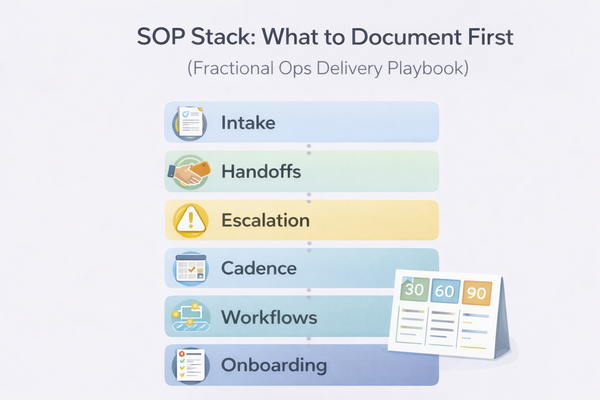
- SOP stack
- 30–60–90 planning
Turn delivery into renewal leverage
If you want to:
- standardize delivery communication,
- reduce renewal anxiety,
- and make expansion feel natural,
Build your Ops fractional profile to this standard.
Build Fractional Profile
Powered by Zeroed