Fractional vs Gig vs Consulting: A Clean Comparison
A clear comparison of fractional work, gig work, and consulting and why confusing them leads to weak positioning and poor pricing.
TL;DR
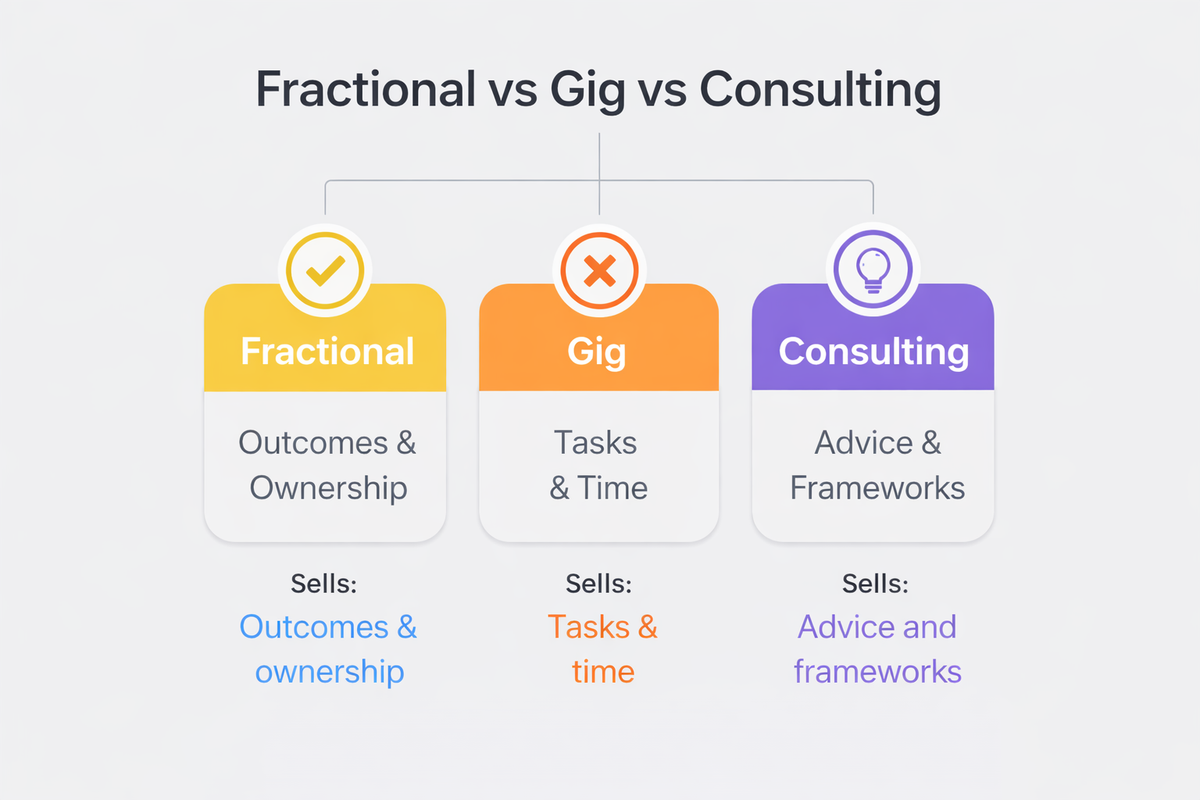
- Gig work sells tasks and time.
- Consulting sells advice and frameworks.
- Fractional work sells outcomes and ownership.
If you position these as interchangeable, buyers will price you like the cheapest option.
Why this distinction matters
Many experienced professionals say,
“I want to do fractional work.”
But buyers often hear:
- freelance help, or
- short-term consulting.
That mismatch leads to:
- price pressure
- unclear scope
- weak authority
- poor retention
Understanding the difference — and signaling it clearly — is foundational to succeeding with fractional work.
The three models, clearly defined
Gig work (task-based)
What it is:
Gig work is transactional. You are hired to complete specific tasks.
How it’s bought:
- short-term
- narrowly scoped
- price-sensitive
- interchangeable providers
Typical signals:
- hourly rates
- task lists
- platform-based sourcing
- minimal context or authority
Example:
“Clean up these reports.”
“Build this dashboard.”
“Set up this automation.”
Gig work optimizes for speed and cost, not ownership.
Consulting (advice-based)
What it is:
Consulting focuses on analysis, diagnosis, and recommendations.
How it’s bought:
- defined engagement
- higher trust in expertise
- deliverables are insights, not execution
Typical signals:
- assessments
- frameworks
- decks and roadmaps
- limited operational ownership
Example:
“Assess our GTM motion.”
“Design an operating model.”
“Recommend improvements.”
Consulting optimizes for clarity and direction, but often stops before sustained execution.
Fractional work (outcome-based leadership)
What it is:
Fractional work is part-time leadership with clear ownership of outcomes.
How it’s bought:
- defined scope or capacity
- recurring cadence
- trust-driven, not transactional
Typical signals:
- outcomes and metrics
- systems and standards
- regular operating rhythm
- accountability over time
Example:
“Stabilize Ops over 90 days.”
“Own RevOps until metrics are predictable.”
“Design and run cadence until the team is self-sufficient.”
Fractional work optimizes for impact, continuity, and ROI.
Side-by-side comparison
| Dimension | Gig | Consulting | Fractional |
|---|---|---|---|
| Primary value | Task execution | Advice & diagnosis | Outcomes & ownership |
| Buyer mindset | Cost + speed | Expertise + insight | Trust + results |
| Duration | Short | Fixed-term | Ongoing / part-time |
| Authority | Low | Medium | High |
| Accountability | Task completion | Recommendations | Business outcomes |
| Pricing anchor | Hourly | Project-based | Retainer / capacity |
Where professionals get stuck
Many professionals accidentally blend models:
- They say they’re fractional…
- …but present themselves like freelancers.
- Or price like consultants.
- Or scope like gigs.
This creates confusion and weakens credibility.
Rule of thumb:
If your profile reads like a resume or task list, buyers will treat you like gig labor.
How buyers actually decide
When companies hire fractional leaders, they look for:
- clarity of scope
- proof of past impact
- ability to operate inside the business
- low perceived risk
They are not comparing you to freelancers.
They are comparing you to:
- full-time hires
- agencies
- consultants
Fractional wins when it feels safer, faster, and clearer.
Choosing the right model (for you)
Ask yourself:
- Do I want to own outcomes, or just execute tasks?
- Am I comfortable being accountable over time?
- Can I define success clearly?
If yes → fractional fits.
If not → consulting or gig work may be more appropriate.
There’s no hierarchy — only alignment.
Why this matters for positioning
Fractional work requires a different signal set:
- offers, not titles
- outcomes, not responsibilities
- proof, not claims
Without this shift, even strong experience gets mispriced.
What to read next
- Who should go fractional (and who shouldn’t)
- How companies buy fractional leadership
- The Fractional Profile Standard
Turn this into a fractional-ready profile
If you want to:
- package your work as outcomes,
- separate yourself from gig and consulting comparisons,
- and present a buyer-ready fractional profile,
Build your fractional profile to this standard.
Build Fractional Profile
Powered by Zeroed