What Is Fractional Work (and What It Isn’t)
A clear explanation of what fractional work actually is and what it isn’t for experienced professionals considering fractional roles.

TL;DR
- Fractional work is part-time leadership, not task-based freelancing.
- You’re hired for outcomes, not hours.
- It sits between full-time employment and traditional consulting.
- It works best where impact can be clearly defined and measured.
Definition: What fractional work actually means
Fractional work is a professional engagement model where experienced leaders deliver defined outcomes for an organization on a part-time, ongoing basis.
Instead of hiring a full-time executive or manager, companies engage a fractional professional for:
- a fixed number of days per week or month, or
- a defined scope (often structured as sprints or retainers)
The focus is ownership, accountability, and results — not task completion.
Why fractional work exists (now)
Fractional work didn’t appear because people wanted flexibility.
It appeared because the economics of hiring changed.
For companies:
- Full-time headcount is expensive and risky
- Hiring cycles are longer
- Business needs are more modular and projectized
For professionals:
- Career paths are less linear
- Waiting for “the next role” is slower and riskier
- Experience compounds faster through outcomes than titles
Fractional work is a practical response to both sides.
What fractional work is
Fractional work has four defining characteristics:
1. Outcome-led
You are hired to move specific metrics:
- reduce cycle time
- stabilize systems
- improve conversion or retention
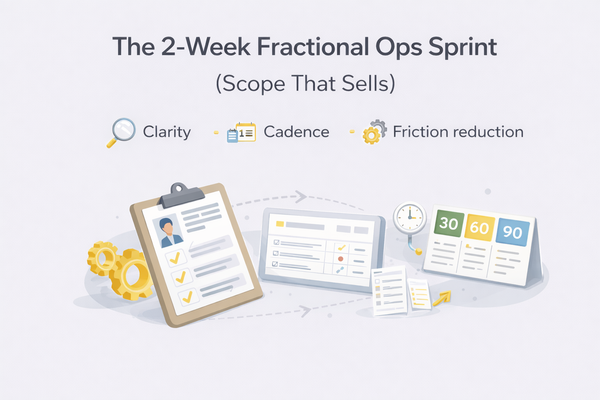
- create clarity and cadence
If outcomes are unclear, the engagement isn’t fractional — it’s vague consulting.
2. Leadership, not execution-only
Fractional professionals:
- set direction
- design systems
- define standards
- unblock teams
They may execute early, but execution supports leadership — not the other way around.
3. Part-time, but persistent
Fractional ≠ short-term help.
Most effective engagements:
- run for multiple months
- include regular cadence (weekly/bi-weekly)
- compound value over time
The goal is continuity without full-time cost.
4. Low-risk for companies
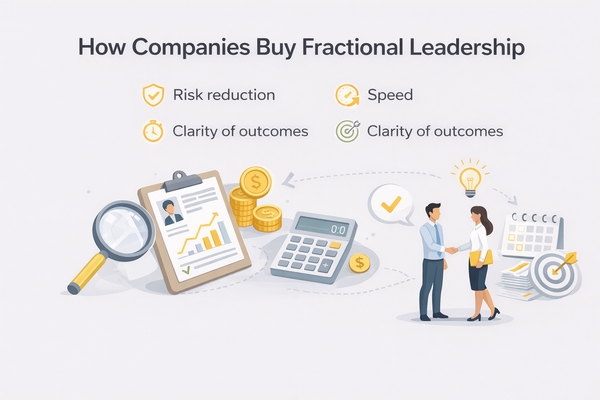
From a buyer’s perspective:
- faster onboarding
- clearer ROI
- easier exit if misaligned
That’s why founders and operators increasingly prefer fractional leadership over permanent hires in uncertain conditions.
What fractional work is not
This distinction matters — especially for positioning.
Not freelancing
Freelancers are hired for tasks.
Fractional professionals are hired for outcomes and ownership.
If you’re being told what to do, rather than what result is expected, the role is not fractional.
Not gig work
Gig platforms optimize for:
- speed
- volume
- price competition
Fractional work optimizes for:
- trust
- impact
- long-term value
The buyer mindset is fundamentally different.
Not traditional consulting (by default)
Consultants:
- deliver recommendations
- often disengage before execution
- operate outside the org
Fractional professionals:
- stay close to execution
- own results
- embed into operating rhythm
Fractional work may include consulting-style thinking, but it doesn’t stop there.
When fractional work makes sense
Fractional roles work best when:
- the problem is important but not full-time
- success can be measured clearly
- leadership gaps are blocking execution
- speed matters more than perfect hiring
Common examples:
- Ops stabilization after growth
- RevOps cleanup before scaling GTM
- Interim leadership during transition
- Systems design before a full-time hire
When it doesn’t
Fractional work struggles when:
- expectations are unclear
- authority is ambiguous
- leadership buy-in is weak
- the company really needs full-time execution power
Not every role should be fractional — and pretending otherwise hurts credibility.
Why this matters for professionals
If you’re positioning yourself for fractional work, this model demands:
- clear offers (not resumes)
- proof of impact (not responsibilities)
- credibility signals (not self-claims)
The way you present your experience must match how buyers think.
What to read next
- Fractional vs Gig vs Consulting: a clean comparison
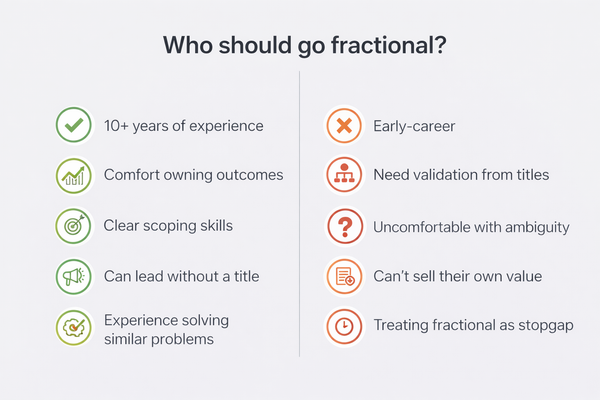
- Who should go fractional (and who shouldn’t)
- How companies buy fractional leadership
Turn this into a fractional-ready profile
If you want to translate your experience into:
- a clear fractional offer,
- outcome-based proof blocks,
- and a shareable profile buyers understand,
Build your fractional profile to this standard.
Build Fractional Profile
Powered by Zeroed