Who Should Go Fractional (and Who Shouldn’t)
A practical guide to who fractional work is a strong fit for and when it’s the wrong model for experienced professionals.
TL;DR
- Fractional work rewards clarity, ownership, and judgment.
- It penalizes ambiguity, weak positioning, and dependency on structure.
- It’s not a fallback for everyone but it’s powerful for the right profile.
Why this question matters
Fractional work is often framed as:
- a flexible alternative, or
- a temporary bridge after a layoff.
That framing is misleading.
Fractional work is a different operating model, not just a different contract.
It fits some professionals extremely well and others poorly.
Understanding which side you’re on before you reposition yourself saves time, credibility, and income.
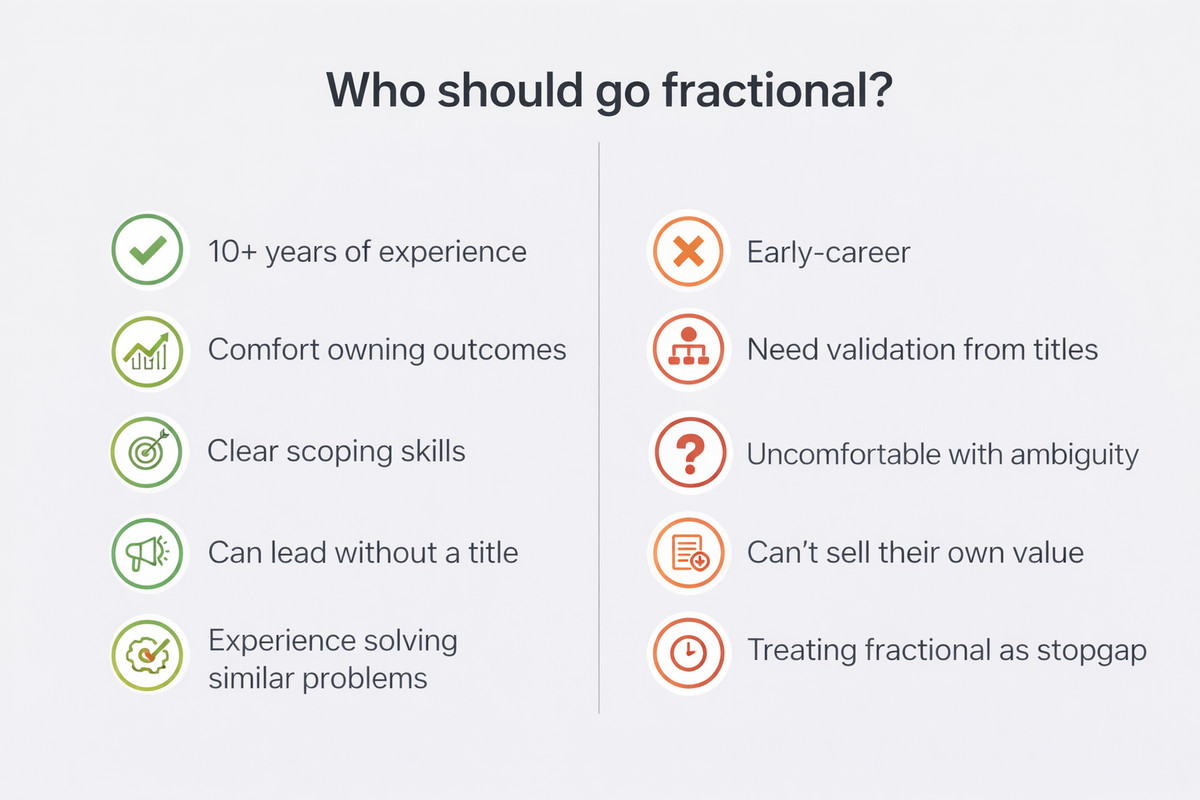
Who fractional work is a strong fit for
1. Professionals with 10+ years of applied experience
Fractional roles favor people who:
- have seen multiple cycles
- understand trade-offs
- can diagnose problems quickly
Depth matters more than novelty.
If most of your value comes from:
- pattern recognition
- judgment calls
- knowing what not to do
You’re already operating fractionally even if you haven’t named it yet.
2. People comfortable owning outcomes (not tasks)
Fractional professionals are hired to:
- stabilize
- unblock
- improve
- systematize
Not to “help out”.
If you’re comfortable being accountable for:
- metrics
- timelines
- decisions
fractional work fits your mindset.
3. Operators who can define scope clearly
Strong fractional operators can answer:
- “What will be different in 30 / 60 / 90 days?”
- “What does success look like here?”
- “What’s explicitly out of scope?”
This ability matters more than technical depth.
If you struggle to define boundaries, fractional work will feel chaotic.
4. People who don’t need a title to lead
Fractional authority is earned through:
- clarity
- consistency
- results
Not hierarchy.
If you can influence without formal power fractional work amplifies that strength.
5. Professionals with repeatable patterns
The strongest fractional profiles are built on:
- repeatable problems solved
- familiar environments
- proven interventions
Examples:
- Ops cleanup after growth
- RevOps stabilization before scale
- Systems design before a full-time hire
If your experience clusters around patterns, fractional work scales well.
Who fractional work is not a good fit for (yet)
1. Early-career professionals
Fractional work assumes:
- independent judgment
- minimal supervision
- comfort with ambiguity
If you still rely heavily on structure, feedback loops, or instruction, fractional roles will feel unsupported.
This isn’t a failure it’s a timing issue.
2. People who need validation from hierarchy
If motivation depends on:
- titles
- reporting lines
- formal authority
Fractional work can feel isolating.
Influence replaces position.
3. Professionals uncomfortable with ambiguity
Fractional roles often start with:
- unclear context
- incomplete data
- shifting priorities
If uncertainty causes paralysis, this model will be stressful.
4. People who can’t sell their own value
Fractional work requires:
- articulating your impact
- framing experience as outcomes
- initiating conversations
If you expect roles to be clearly defined for you, fractional work will frustrate you.
5. Anyone treating fractional as “just temporary”
Fractional work works best when treated as:
- a deliberate operating model
- not a stopgap
Approaching it casually leads to weak positioning and inconsistent income.
A self-assessment (quick test)
You’re likely fractional-ready if most of these are true:
- You’ve solved similar problems multiple times
- You can define outcomes without a job description
- You’re comfortable being accountable without authority
- You can explain your value without a resume
- You prefer ownership over busywork
If several are false, that’s useful data not a judgment.
Fractional readiness is buildable
Many professionals aren’t fractional-ready by default but can become so by:
- clarifying offers
- documenting outcomes
- tightening scope
- creating proof assets
This is a process, not a personality trait.
What to read next
- How companies buy fractional leadership
- The Fractional Profile Standard
- From experience to offer: packaging your value
Turn readiness into a fractional profile
If you want to:
- test whether you’re fractional-ready,
- translate experience into outcomes,
- and present yourself clearly to buyers,
Build your fractional profile to this standard.
Build Fractional Profile
Powered by Zeroed